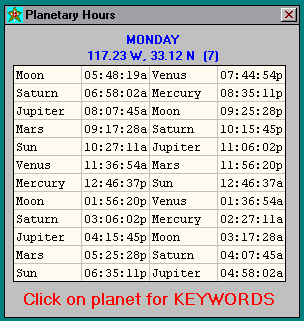
B elow are complete instructions for The Planetary Hours Program, easy to use astrological software for Windows 95, 98, Me and XP that instantly computes the planetary hours. Thousands of pre-defined locations in the U.S. Make set up simple. Here are easy to print text file TPHP Instructions. Hours programs display listings of any day's planetary hours, their rulers, and the times the hours start. Max Heindel has said that the study and use of planetary hours can bring wonderful opportunities for soul growth if they are used to help our fellowman. Now you can begin to use them in a conscious.
- Planetary Hours Program With Answers
- How To Use Planetary Hours
- Planetary Hours Program
- Planetary Hours Astrolabe
Download PDF
June Solstice 2021
'Just Nuke 'Em!' Planetary Defense in the Movies
What two famous 1998 asteroid movies got right and wrong.Risky business: will the world rise to the challenge of asteroid defense?
This November, NASA will launch the world’s first mission to test a method of deflecting an asteroid.Your Impact: June Solstice 2021
Our annual Day of Action set up virtual meetings between 145 members and their congressional representatives and staffers.Planetary Hours Program With Answers
Your Place in SpaceDisasters Aren’t Inevitable: Planning Ahead to Protect Our World
By Bill Nye, Planetary Society CEO
Our world is fragile. The COVID-19 pandemic reminds us that we are all in this together on our planet. When trouble started in one part of the world, it quickly touched every one of us.
The analogy from pandemic to asteroid impact is compelling. A major impact anywhere in the world would have enormous consequences. It would affect every single person on Earth, either directly or indirectly. Lives would be lost. Some people would be forced to migrate. Economies would slow or even collapse depending on the impact’s size and location.
If a potentially disastrous incoming object were identified—one that would impact here, say, 20 years hence—would we work together? Would governments cooperate or be paralyzed by mistrust? Would science deniers and contrarians carry the day and prevent significant action? After the catastrophe, would we lend a hand to one another, or would rivalries and inequities be amplified? No matter the eventual outcome, we would once again be painfully reminded that as Earthlings, we are all affected by forces of nature, whatever they may be.
A global pandemic is akin to a massive asteroid impact in yet another way. Both could be prevented if we were to put in enough time, effort, and energy—and if we have the right systems in place. For most of us, contemplating the effects of an asteroid or comet impact often brings to mind apocalyptic images from science fiction, but by studying distant objects that might threaten us, we can indeed prepare for a potential orbital collision. The threat is real, and we are the first generation of humans able to get ready and be set to deflect an incoming asteroid. Fundamentally, it will require investment by governments around the world. Here at The Planetary Society, we’ve been advocating for those investments for many years, and thanks to the support of members like you, we’ve made progress.
If there’s one thing we can learn from the enormous challenges created by the pandemic, it’s that we have to work together to protect our species. Our world is fragile. We aren’t invincible, but when we pool our considerable talents, we humans are a force to be reckoned with. Let’s not let an asteroid prove otherwise.
This issue of The Planetary Report highlights the important things we should all know about the threat of incoming asteroids along with the work we’re doing to defend Earth from such impacts. We also celebrate the impact (pun very much intended) that your membership has already made on planetary defense efforts and share new ways that you can get involved to help defend Earth. Let’s go!
Members on DeckOur Members Kick Asteroid
By Ellen McSorley, a Planetary Society member and donor from Monmouth County, New Jersey
In February 2013, an asteroid blasted through the air over Chelyabinsk, Russia. Thousands of buildings were damaged, and hundreds of people were injured. I asked myself, “How did this go undetected?”
In 2017, I was reading an article about Bill Nye, CEO of The Planetary Society, and asked my good friend Google, “What’s The Planetary Society?” Searching through the website and reading about different projects in which the Society was involved, I came upon a page about defending Earth from asteroid impacts. “Wow,” I thought, “someone is doing something about this.” Reading further, I discovered that the Society has the Shoemaker NEO (near-Earth object) Grant program to help amateur astronomers find and track potentially dangerous asteroids.
Soon after my discovery, the Society held a fundraiser through Kickstarter for planetary defense. I had the opportunity to be involved in a project that could very well save the world! Asteroid impacts are the one natural disaster about which we can actually do something.
Since then, I’ve been hooked on planetary defense. In 2020, I attended the Day of Action in Washington, D.C., and planetary defense was my favorite talking point. I had the opportunity to educate members of Congress about this important mission.
I’m hoping that at this year’s Day of Action, I can spark interest in the funding of the NEO Surveyor space telescope so that a disaster like the one in Chelyabinsk won’t happen again.
Want to know more? I highly recommend the video series by Dr. Bruce Betts on defending Earth from asteroids, available at planetary.org/asteroid-video. Hey, it has dinosaurs! Who could ask for more?
Get InvolvedThe Threat Is Real. The Answer Is Science... Powered By YOU.
Last September, Brazilian amateur astronomer Leonardo Amaraldiscovered a kilometer-wide, near-Earth asteroid that would createglobal devastation if it hit our home planet. Thankfully, the asteroidQU6 was of no risk to us due to its distance from Earth.
But the fact that a near-Earth object (NEO) large enough to destroy amajor city had gone undetected until Leonardo’s discovery proves wemust work urgently to defend Earth from deadly asteroids! This is whereyou come in...
Thanks to funding from members like you, Leonardo received aShoemaker NEO grant from The Planetary Society in 2019 for a newtelescope mount that allows him to observe dimmer objects.
His work underscores the immense value of our grants, given every twoyears to fund equipment upgrades for passionate astronomers who spendcountless hours working to find, track, and characterize near-Earthobjects.
Will you please power this important work with your contribution? Actnow and your gift will be matched dollar for dollar up to a total of$25,000!
DONATE NOW AT PLANETARY.ORG/NEO.
How Can I Help Defend the Planet?
ADVOCATE
U.S. residents can sign a petition to Congress advocating for the NEO Surveyor mission to rapidly detect and characterize hazardous near-Earth objects. Find the petition at planetary.org/action-center.
SPREAD THE WORD
Help raise awareness about the asteroid threat by giving a presentation to a local astronomy club, student group, or even just your friends and family. Check out our planetary defense presentation kit at planetary.org/outreach-toolkits.
GET EDUCATED
Brush up on asteroid impacts and how to prevent them with our free Asteroid Defense 101 course at courses.planetary.org.
Celebrate Asteroid Day With Us!
June 30 is Asteroid Day, a UN-sanctioned global awareness campaign that takes place every year on the anniversary of the Tunguska event in 1908, the most harmful known asteroid-related event in Earth’s recent history. Asteroid Day’s mission is to inspire, engage, and educate the public about asteroid opportunities and risks. The Planetary Society is a proud partner and is helping to develop Asteroid Day LIVE, a free live broadcast that mixes education and entertainment. Go to asteroidday.org to learn more and tune in on June 30 to join the celebration.
Make Your Mark on The Planetary Society

There are so many ways to honor your heroes and loved ones. As a Planetary Society member, we invite you to do so while also supporting our mission to advance space science and exploration. By buying a custom-inscribed brick that paves the front of our headquarters in Pasadena, California, you can leave a permanent mark on the future of our organization while helping us achieve our mission. Learn more at planetary.org/brick.
Bringing the Cosmos to You Every Week
If you aren’t already subscribed to our weekly email newsletter, The Downlink, sign up today! Every Friday, we send you the latest space news, amazing space images, inspiring artwork, updates on The Planetary Society’s work, and ways that you can get involved. There’s no better way to stay connected to our global community of space advocates. Sign up at planetary.org/connect.
What's Up?A Supermoon and Meteor Shower
How To Use Planetary Hours
By Bruce Betts, Planetary Society Chief Scientist
On June 24, look for a supermoon, which is when the Moon looks extra large and bright. This happens whenever the Moon is on the opposite side of Earth from the Sun, fully illuminating its face while closest to Earth in its elliptical orbit. Reddish Mars will be sinking lower in the west soon after sunset through June and July. Super-bright Venus will be low in the west soon after sunset through September. Venus and Mars grow closer in the sky until July 12/13, when they will be as close as the width of a full Moon (about half a degree). Bright Jupiter and yellowish Saturn are in the same region of the sky, rising in the east in the late evening in June and the early evening by September. The Perseid meteor shower peaks August 12/13, with increased activity several days before and after. The most meteors will occur after midnight, and the Moon will have set by then, leaving a darker sky. For more night sky tips, you can always check out planetary.org/night-sky.
Random Space Fact
The Moon, with a diameter of 3,474 kilometers (2,159 miles), is larger than each of the dwarf planets, the largest being Pluto, with a diameter of 2,377 kilometers (1,477 miles).
Planetary Hours Program
Trivia Contest
Our December solstice contest winner is Jim Derivera of Oxnard, California. Congratulations! The question was: What was the only Apollo spacecraft call sign named after a single star? The answer: The Apollo 14 Lunar Module call sign was Antares, named after the star that would be used to orient the Lunar Module during landing.
Try to win a copy of Astronomy for Kids by Bruce Betts and a Planetary Radio T-shirt by answering this question: What is the largest asteroid considered to be a near-Earth object (NEO)?
Email your answer to [email protected] or mail your answer to The Planetary Report, 60 S. Los Robles Ave., Pasadena, CA 91101. Make sure you include the answer and your name, mailing address, and email address (if you have one). By entering this contest, you are authorizing The Planetary Report to publish your name and hometown. Submissions must be received by September 1, 2021. The winner will be chosen in a random drawing from among all the correct entries received.
For a weekly dose of “What’s Up?” complete with humor, a weekly trivia contest, and a range of significant space and science-fiction guests, listen to Planetary Radio at planetary.org/radio.
Astronomical ArtWilliam Hartmann, View of the 1908 Tunguska Fireball From the Town of Kirensk
On the morning of June 30, 1908, an asteroid roughly 50 to 80 meters wide (160 to 260 feet wide) exploded above Tunguska, Siberia, leveling 2,000 square kilometers (770 square miles) of forest. No known pictures of the moment of impact exist, but Russian scientists collected eyewitness accounts from people up to hundreds of kilometers away.
William Hartmann, a planetary scientist and prolific space artist, used these reports to paint reenactments of the event from different distances and perspectives. Here, a schoolteacher in Kirensk, which is 400 kilometers (250 miles) southeast of ground zero, shields her eyes while watching the meteorite just seconds before it explodes.
Do you want to see your artwork here? We love to feature our members throughout this magazine. Send your original, space-related artwork to [email protected]
Planetary Hours Astrolabe
ChronosXP is a planetaryhours astrology program for Windows. It runs from the system tray where it displays a glyph corresponding to the current planetary hour. Planetary hours/days can also be viewed for any given time or. ...
- ChronosXP
- Robert Misiak
- Freeware (Free)
- 477 Kb
- Windows XP, 2000, 98, Me, NT
MB Western Astrology Planetary Aspects calculates the angular distance or aspects between different planets based on Western Astrology. MB Western Astrology Planetary Aspects finds the angular distances between planets according to the Western Astrology principles and interprets the influences of the planetary aspects on you. Using this wonderful tool for western astrology planetary aspects reading you can know how your basic tendencies and other personality traits are influenced by the planet aspects or the angular planetary positions.
- MBFreeWesternAstrologyPlanetaryAspects.exe
- MysticBoard.com
- Shareware ($)
- 1.44 Mb
- WinXP, WinNT 4.x, WinME, Win2003, Win2000, Win Vista, Win98, Win95
MB Planetary Relationships displays the kind of relationship shared between different planets. MB Planetary Relationships Software finds the planetary patterns as they appear in your natal chart and interprets the relationships among the planets. The astrology planetary relationships depend on which houses they are placed in and also on their relative positions with respect to the other planets.
- MBFreePlanetaryRelationships.exe
- MysticBoard.com
- Shareware ($)
- 1.21 Mb
- WinXP, WinNT 4.x, WinME, Win2003, Win2000, Win Vista, Win98, Win95
MB Astrology Planetary Patterns Software finds the planetary patterns as they are displayed in your astrology natal chart and tells you the influences of the astrological planets considering their planetary patterns or planet positions. The. ...
- MBFreeAstrologyPlanetaryPatterns.exe
- MysticBoard.com
- Freeware (Free)
- 1.63 Mb
- Win95, Win98, WinME, WinNT 4.x, Windows2000, WinXP, Windows2003, Windows Vista
Calculate time between 2 date/times, or date/time a given time from a date/time Time Difference Calculator will calculate the number of days, hours, and minutes between two dates and times. Just input two dates and times (such as Dec.
- tdcarc.exe
- Leithauser Research
- Shareware ($20.00)
- 481 Kb
- Win95,Win98,WinME,WinNT 3.x,WinNT 4.x,Windows2000,WinXP,Windows2003,Win Vista
The calculator is a simulation tool that enables the user determine the best way to tool their chamber and the best placements for their deposition sources. It can also be used to calculate the expected effect of planetary substrate holders.
- Thin Film UniformityCalculator
- thinfilmuniform SourceforgeProject
- Freeware (Free)
- Windows
Planetary Interaction calculator for Eve Online. Allows to calculate which resources at which planets should be gathered in order to manufacture high level products..
- PICalc-v1.0.2-beta-src.zip
- picalc
- Freeware (Free)
- 250 Kb
- Windows
MB Vedic Astrology Drishti (Aspects) calculates your aspects according to Vedic Astrology. This includes Rashi Drishtis (Sign Aspects), Graha Drishti (Planetary Aspects) and Sputa Drishti (Angular Aspects). MB Vedic Astrology Drishti (Aspects) Software is the perfect tool for you if you want to know the angular aspects of the astrology planets on each other and their influences on your nature, character and personality traits.
- MBFreeVedicAstrologyDrishtiAspects.exe
- MysticBoard.com
- Shareware ($)
- 1.21 Mb
- WinXP, WinNT 4.x, WinME, Win2003, Win2000, Win Vista, Win98, Win95
This simple man-hourscalculator is an easy manager tool that figures out if you have the man-power available to handle your employee coverage needs to get the job done. It will show you how many man-hours you are over, or under.
- MHC10.exe
- Employee SchedulingSolutions
- Freeware (Free)
- 3.81 Mb
- Windows
MB Western Astrology Planetary Dignities shows the rulership of the planets in the signs they are present in based on Western Astrology. Each planet may or may not be compatible with the sign it is present in. The placements effects the expression of the characteristics reflected by the planet.
- MBFreeWesternAstrologyPlanetaryDignities.exe
- MysticBoard.com
- Shareware ($)
- 1.3 Mb
- WinXP, WinNT 4.x, WinME, Win2003, Win2000, Win Vista, Win98, Win95
Planetary Defense is a space strategy game where you take charge of a planets defenses against waves of attacking aliens. Defend against missiles, multiple warhead rockets, cloaked starships, meteors, homing missiles and laser-armed satellites.
- planetarydefense_demo.exe
- Positech Computing Ltd
- Shareware ($19.95)
- 2.93 Mb
- Windows 9X, ME, 2K, XP, 2003
Spacejunk is a computer game about traveling in 2D planetary systems. The player must collect drifting garbage by navigating through the gravitational fields of planets and stars. A rough editor for planetary systems is provided too.
- spacejunk-1.0.4.tar.gz
- facundominguez
- Freeware (Free)
- 7.3 Mb
- Linux
Related:Planetary Hours Calculator - Planetary Hours Houston - Planetary Hours Software - Countdown Calculator Hours - Calculator Add Hours